• Is The Issue Of Health Care Pushing Your Buttons?

  • Share Your Story

    If you have a story to share about healthcare issues in South Carolina, we want to hear it!

The Individual Mandate’s Shameless Flip-Floppers

From The Hill:

GOPers Who Were For It Before They Were Against It

By Juan Williams

12/05/11 05:15 AM ET

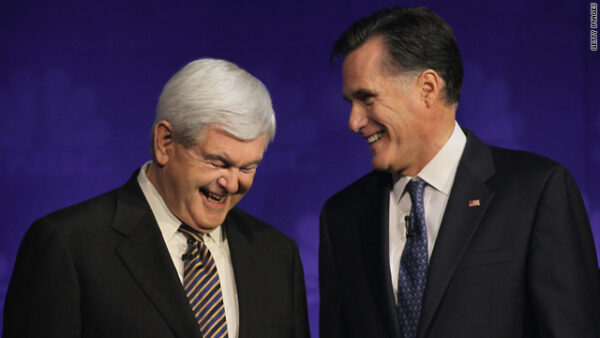
What do Newt Gingrich and Mitt Romney, the leading contenders for the Republican presidential nomination, have in common?

Long before President Obama, both supported an idea they now pretend to spurn — the idea of requiring people to buy health insurance.

As recently as 2009, Romney publicly supported, the “individual mandate” for buying health insurance. And as recently as last month one of Gingrich’s websites still endorsed the “mandate” for all Americans earning more than $50,000 annually.

Romney and Gingrich are not alone in their history of supporting the idea of a government requirement that everyone buy health insurance. As governor of Utah in 2007, Jon Huntsman endorsed a healthcare reform plan from the United Way of Salt Lake City that called for a mandate.

“I think if you’re going to get it done and get it done right, the mandate has to be part of it in some way, shape or form,” he said at the time.

Gingrich, Romney and Huntsman are wide open to charges of political hypocrisy.

They apparently feel the need to fake their outrage over the individual mandate to win the GOP nomination. In an age of outrageous political posturing — telling lies and daring anyone to call you on it — this is the strongest indicator of the current lack of leadership and honest political debate about major national problems.

And it is not even good politics. (more…)

Haley’s Waiting Game On S.C.’s Health Insurance Exchange

From Kaiser Health News:

S.C.’s top health official, Anthony Keck, and Gov. Nikki Haley, not fans of the 2010 health law, are likely to decide to let the federal government run the state’s exchange. (Haley photo by MaryAustinPhoto via Flickr)

By Christopher Weaver

Nov 15, 2011

South Carolina’s top health official will recommend this week that the state decline creating its own health insurance exchange, one of the central tenets of President Barack Obama’s health care law.

Instead, the state should let the federal government build the insurance marketplace in the state for now, Anthony Keck, the director of the state’s Department of Health and Human Services, said in an interview. That recommendation is expected to go to a committee appointed by the governor to study the issue on Friday.

South Carolina, a state dominated by health-law-averse Republicans who got a Tea Party boost in last year’s election, has been heading down this road for months. But the recommendation is the latest step in formalizing objections to the exchange — and it frames the move as pragmatism, even as the state hands over power to the federal government.

The No. 1 reason for the wait-and-see approach? The stakes are so low. If a state does nothing, Washington is required to step in and build an exchange by 2014. That thinking — as well as a list of technical and logistical problems — is swaying decision-makers in other states too, industry analysts say.

State officials say the 2014 deadline is too tight given that rules for the exchanges are not complete, which is one incentive to defer to Washington. Plus, if South Carolina officials don’t like the federally run exchange, they can always circle back and start their own later under rules issued by the federal health department in July.

“What is the first mover advantage for states to rush ahead and implement this, given all the uncertainty?” Keck asked. “States have the safety valve of being able to take it over when they want to.”

“Sometimes, the smartest thing when you’re doing something new like this is to wait,” he said. (more…)

South Carolina: Home Of Individual-Mandate Hypocrisy

From Slate:

South Carolina Gov. Nikiki Haley | Credit: Chip Somodevilla/Getty Images.

Why aren’t conservatives complaining about this South Carolina insurance law?

By |

Posted Friday, Sept. 30, 2011

The “individual mandate” in President Obama’s Affordable Care Act has provoked incredible enthusiasm among the act’s supporters and towering rage in its opponents. The obligation either to purchase insurance or to pay a fine whose proceeds would be used to offset the cost of care to the uninsured is viewed either as an essential part of the architecture of health care reform or as an affront to liberty. In few places has the attack on the individual mandate been more vociferous than in South Carolina, where both new Governor Nikki Haley and Senator Jim DeMint are leading members of the Tea Party movement. They view the individual mandate as inimical to our Constitution and the worst manifestation of government excess.

So it may surprise you to know that South Carolina has its own individual mandate—structured exactly like the federal health care mandate, but for auto insurance. Unlike virtually all other states, which require every driver to carry liability insurance, South Carolina has a more complex system. Under South Carolina state law, in effect for more than a decade, a car owner in the state must either have liability insurance or obtain an “uninsured motorist registration.” The fee for the uninsured registration is $550 and is deposited into the “uninsured drivers fund.” The website of the South Carolina Department of Insurance explains that the $550 fee is used to “offset the costs of uninsured motorist coverage.” (Some portion is also used for consumer education programs.) The “uninsured motorist coverage” is a cost borne by drivers who have their own liability insurance but also need additional insurance to provide for coverage in the event they have an accident caused by a driver who does not have liability insurance—the “uninsured driver.”  By statute—SC Code section 38-77-155—funds from the uninsured drivers fund are distributed to insurers who offer this uninsured motorist coverage. Bottom line: South Carolina forcibly transfers money from drivers who refuse to buy insurance to drivers who do buy insurance to cover the costs of risk created by the drivers who don’t buy insurance. (more…)

Follow

Get every new post delivered to your Inbox.